
Before I read Maus, I had two questions I couldn’t shake: Why comics? And why mice? These seem like simple, even naive questions, but sitting with them during one of my graduate class discussions in 2019 opened up something I wasn’t quite prepared for. Maus is not just a book; it is an experience, a reckoning, and one that everyone owes themselves at least once in their lifetime.
Let me start with the obvious: Maus is a graphic novel. But don’t let that fool you into thinking it is light reading or something you can breeze through on a lazy afternoon. Art Spiegelman uses the comics medium to tell the story of his father, Vladek, a Polish Jewish Holocaust survivor, while simultaneously telling his own story of trying to understand a past he didn’t live but has always carried deep in his bones. The narrative moves back and forth between wartime Poland and present-day New York, between father and son, and between unspeakable horror and something, oddly, painfully funny. And somehow, against all odds, it all works beautifully.
Why Comics?
This was the question that nagged at me first. My professor at the time, Dr. Marie Tedesco’s class lectures, and Valerie Bodell’s video lecture genuinely changed how I understood the medium. Comics, they explained, are sequential images with or without text, and they have evolved far beyond superheroes and punchlines into a powerful vehicle for personal storytelling. Spiegelman is precisely that kind of storyteller. When asked why he chose comics, he said it could never have occurred to him to tell this story in any other form. For him, it was simply natural.
And when you read Maus, you understand why. Spiegelman once described his fascination with comics as being about “the abstraction and structuring that come with the comics page, the fact that moments in time are juxtaposed.” That juxtaposition is everything. The comics format lets him move fluidly between past and present, between Auschwitz and a Queens apartment, without the jarring disorientation that might come in another medium. There is a remarkable page in Maus II where this becomes viscerally clear: time collapses, and you feel it visually before you even process it intellectually.
What also struck me is how the format actually protects the reader emotionally. The switches in time and place give you breathing room so you are never completely submerged in the trauma. You remember some things and forget others in the reading process, which, when you think about it, is exactly how memory and grief work in real life. Unlike a film, which pulls you relentlessly forward, comics let you pause. You control the pace. You linger on a panel or move through it quickly. That power given to the reader feels intentional and deeply humane.

Why Mice?
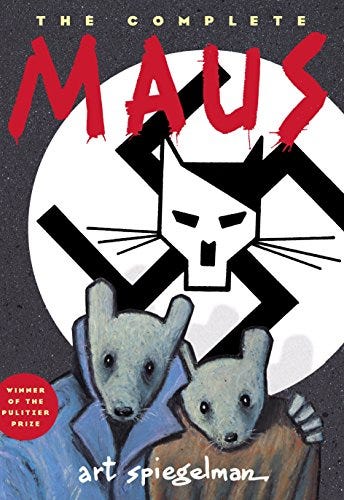
My first instinct when I asked myself this question was fairly straightforward: cats hunt mice, predator and prey, a clean metaphor for oppressor and oppressed. And that is part of it. But the more I sat with it, the more layers revealed themselves. In Maus, Jews are drawn as mice, Nazis as cats, Poles as pigs, French as frogs, and Americans as dogs. What is remarkable is that the characters look almost interchangeable within their groups, and that sameness is the point. These were ordinary people, just like you, who found themselves inside a collective nightmare.
But it goes so much deeper than visual metaphor. Spiegelman later discovered that Nazi propaganda had long depicted Jews as vermin rats swarming in sewers, filth-covered and subhuman. A 1940 German propaganda film called The Eternal Jew used exactly this imagery. By reclaiming it and turning it into art, Spiegelman performs something quietly radical and almost defiant. He takes the dehumanizing weapon that was used against his people and dismantles it from the inside, forcing readers to confront how monstrous that original dehumanization truly was.
The Weight Artie Carries
What stayed with me most powerfully, though, was not Vladek’s Holocaust story, harrowing as it is, but Artie himself. He is not a passive narrator sitting at a comfortable distance from events. He is a man quietly crushed under the weight of a history he did not experience firsthand but cannot escape. Psychologists call this transgenerational trauma: the cumulative emotional and psychological wounds passed down from one generation to the next, transmitted not through words or deliberate teaching but through atmosphere, silence, guilt, and grief.
You see it everywhere in Artie in his guilt, his shame, his fractured sense of self, and his inability to fully inhabit his own life because he is so busy living his parents’ past. At one point in the book, he literally draws himself wearing a mouse mask over his human face. That single image communicated more to me than pages of prose ever could. He is performing an identity he has inherited rather than one he has chosen. He lives two lives simultaneously: his own and the one that preceded him.
I found myself deeply empathizing with Artie, perhaps because there is something universal in the experience of carrying your family’s pain without having asked for it. His relationship with his mother, Anja, is particularly heartbreaking. Her final words to him were a question: “Artie, you still love me, don’t you?” and his indifference in that moment haunts the entire book. He blames himself for her suicide. He thinks of himself as a failure. That guilt never leaves him, and Spiegelman does not let the reader off the hook either. We sit with it alongside him.
Vladek: A Difficult Man, an Impossible Story
Vladek, the father, is equally compelling and deliberately, unapologetically imperfect. He is miserly, difficult, manipulative at times, and yes, racist toward Black people in ways the book does not excuse or ignore. When I first encountered that aspect of his character, it felt jarring. Here is a man who suffered the worst of racial persecution, carrying his own prejudices forward. But Spiegelman never lets you dismiss Vladek, and he never lets you flatten him into either a hero or a villain.
Beneath all those sharp, exhausting edges is a man who never really survived the Holocaust, not fully, not in any way that mattered for how he lived the rest of his life. His trauma calcified into personality. His survival instincts, bribing, bartering, hoarding, and trusting no one, became permanent fixtures long after the war ended. A character in the book says it plainly and devastatingly: “In some ways, he didn’t survive.” That line broke something open in me when I first read it, and it still does.
Why This Book Matters Right Now
I also want to say this plainly: Maus won the Pulitzer Prize in 1992, the first graphic novel ever to do so. It was banned by a Tennessee school board in 2022, ostensibly over nudity and profanity. Both of those facts tell you everything about why this book continues to matter. Great art makes people uncomfortable. Great art refuses to look away from difficult truths. And great art, apparently, still frightens people enough that they want it out of classrooms. Maus does all of these things.
The Holocaust is not ancient history. The traumas it produced are still unfolding in families, in communities, and in the bodies and psyches of descendants who never saw a concentration camp but grew up inside the long shadow of one. Maus makes that inheritance visible in a way that no textbook, documentary, or conventional memoir quite manages. It shows you what it looks like to love someone who has been broken by history and to be broken a little yourself by loving them.
Final Thoughts
Reading Maus in graduate school changed how I think about storytelling, memory, and what we owe to the generations that came before and those that will come after us. It is not an easy read; it will sit with you, disturb you, and make you ask uncomfortable questions about survival, guilt, identity, and what it means to bear witness to someone else’s pain. But that discomfort is exactly the point.
If you have never picked it up, do it. If you read it years ago and thought it was just a Holocaust book in comic form, read it again because it is so much more than that. It is a book about fathers and sons, about memory and forgetting, and about the stories we inherit and the ones we choose to tell. And it is, without question, one of the most important books I have ever read.
Why I Think Everyone Should Read Maus by Art Spiegelman
Before I read Maus, I had two questions I couldn’t shake: Why comics? And why mice? These seem like simple, even naive questions, but sitting with them during one of my graduate class discussions in 2019 opened up something I wasn’t quite prepared for. Maus is not just a book; it is an experience, a reckoning, and one that everyone owes themselves at least once in their lifetime.
Let me start with the obvious: Maus is a graphic novel. But don’t let that fool you into thinking it is light reading or something you can breeze through on a lazy afternoon. Art Spiegelman uses the comics medium to tell the story of his father, Vladek, a Polish Jewish Holocaust survivor, while simultaneously telling his own story of trying to understand a past he didn’t live but has always carried deep in his bones. The narrative moves back and forth between wartime Poland and present-day New York, between father and son, and between unspeakable horror and something, oddly, painfully funny. And somehow, against all odds, it all works beautifully.
Why Comics?
This was the question that nagged at me first. My professor at the time, Dr. Marie Tedesco’s class lectures, and Valerie Bodell’s video lecture genuinely changed how I understood the medium. Comics, they explained, are sequential images with or without text, and they have evolved far beyond superheroes and punchlines into a powerful vehicle for personal storytelling. Spiegelman is precisely that kind of storyteller. When asked why he chose comics, he said it could never have occurred to him to tell this story in any other form. For him, it was simply natural.
And when you read Maus, you understand why. Spiegelman once described his fascination with comics as being about “the abstraction and structuring that come with the comics page, the fact that moments in time are juxtaposed.” That juxtaposition is everything. The comics format lets him move fluidly between past and present, between Auschwitz and a Queens apartment, without the jarring disorientation that might come in another medium. There is a remarkable page in Maus II where this becomes viscerally clear: time collapses, and you feel it visually before you even process it intellectually.
What also struck me is how the format actually protects the reader emotionally. The switches in time and place give you breathing room so you are never completely submerged in the trauma. You remember some things and forget others in the reading process, which, when you think about it, is exactly how memory and grief work in real life. Unlike a film, which pulls you relentlessly forward, comics let you pause. You control the pace. You linger on a panel or move through it quickly. That power given to the reader feels intentional and deeply humane.
Why Mice?
My first instinct when I asked myself this question was fairly straightforward: cats hunt mice, predator and prey, a clean metaphor for oppressor and oppressed. And that is part of it. But the more I sat with it, the more layers revealed themselves. In Maus, Jews are drawn as mice, Nazis as cats, Poles as pigs, French as frogs, and Americans as dogs. What is remarkable is that the characters look almost interchangeable within their groups, and that sameness is the point. These were ordinary people, just like you, who found themselves inside a collective nightmare.
But it goes so much deeper than visual metaphor. Spiegelman later discovered that Nazi propaganda had long depicted Jews as vermin rats swarming in sewers, filth-covered and subhuman. A 1940 German propaganda film called The Eternal Jew used exactly this imagery. By reclaiming it and turning it into art, Spiegelman performs something quietly radical and almost defiant. He takes the dehumanizing weapon that was used against his people and dismantles it from the inside, forcing readers to confront how monstrous that original dehumanization truly was.
The Weight Artie Carries
What stayed with me most powerfully, though, was not Vladek’s Holocaust story, harrowing as it is, but Artie himself. He is not a passive narrator sitting at a comfortable distance from events. He is a man quietly crushed under the weight of a history he did not experience firsthand but cannot escape. Psychologists call this transgenerational trauma: the cumulative emotional and psychological wounds passed down from one generation to the next, transmitted not through words or deliberate teaching but through atmosphere, silence, guilt, and grief.
You see it everywhere in Artie in his guilt, his shame, his fractured sense of self, and his inability to fully inhabit his own life because he is so busy living his parents’ past. At one point in the book, he literally draws himself wearing a mouse mask over his human face. That single image communicated more to me than pages of prose ever could. He is performing an identity he has inherited rather than one he has chosen. He lives two lives simultaneously: his own and the one that preceded him.
I found myself deeply empathizing with Artie, perhaps because there is something universal in the experience of carrying your family’s pain without having asked for it. His relationship with his mother, Anja, is particularly heartbreaking. Her final words to him were a question: “Artie, you still love me, don’t you?” and his indifference in that moment haunts the entire book. He blames himself for her suicide. He thinks of himself as a failure. That guilt never leaves him, and Spiegelman does not let the reader off the hook either. We sit with it alongside him.
Vladek: A Difficult Man, an Impossible Story
Vladek, the father, is equally compelling and deliberately, unapologetically imperfect. He is miserly, difficult, manipulative at times, and yes, racist toward Black people in ways the book does not excuse or ignore. When I first encountered that aspect of his character, it felt jarring. Here is a man who suffered the worst of racial persecution, carrying his own prejudices forward. But Spiegelman never lets you dismiss Vladek, and he never lets you flatten him into either a hero or a villain.
Beneath all those sharp, exhausting edges is a man who never really survived the Holocaust, not fully, not in any way that mattered for how he lived the rest of his life. His trauma calcified into personality. His survival instincts, bribing, bartering, hoarding, and trusting no one, became permanent fixtures long after the war ended. A character in the book says it plainly and devastatingly: “In some ways, he didn’t survive.” That line broke something open in me when I first read it, and it still does.
Why This Book Matters Right Now
I also want to say this plainly: Maus won the Pulitzer Prize in 1992, the first graphic novel ever to do so. It was banned by a Tennessee school board in 2022, ostensibly over nudity and profanity. Both of those facts tell you everything about why this book continues to matter. Great art makes people uncomfortable. Great art refuses to look away from difficult truths. And great art, apparently, still frightens people enough that they want it out of classrooms. Maus does all of these things.
The Holocaust is not ancient history. The traumas it produced are still unfolding in families, in communities, and in the bodies and psyches of descendants who never saw a concentration camp but grew up inside the long shadow of one. Maus makes that inheritance visible in a way that no textbook, documentary, or conventional memoir quite manages. It shows you what it looks like to love someone who has been broken by history and to be broken a little yourself by loving them.
Final Thoughts
Reading Maus in graduate school changed how I think about storytelling, memory, and what we owe to the generations that came before and those that will come after us. It is not an easy read; it will sit with you, disturb you, and make you ask uncomfortable questions about survival, guilt, identity, and what it means to bear witness to someone else’s pain. But that discomfort is exactly the point.
If you have never picked it up, do it. If you read it years ago and thought it was just a Holocaust book in comic form, read it again because it is so much more than that. It is a book about fathers and sons, about memory and forgetting, and about the stories we inherit and the ones we choose to tell. And it is, without question, one of the most important books I have ever read.
References
Bakó, T., & Zana, K. (2018). The vehicle of transgenerational trauma: the transgenerational atmosphere. American Imago, 75(2), 271–278.
Burton, N. (2015, May 23). Empathy vs. sympathy. Psychology Today. https://www.psychologytoday.com/us/blog/hide-and-seek/201505/empathy-vs-sympathy
Dass-Brailsford, P. (2007). A practical approach to trauma: Empowering interventions. SAGE Publications.
LaCapra, D. (2014). Holocaust testimonies: Attending to the victim’s voice. In Writing history, writing trauma (pp. 86–113). Johns Hopkins University Press. (Original work published 2001)
Leon S. (n.d.). [Video testimony]. YouTube.
Helen K. (n.d.). [Video testimony]. YouTube.
Spiegelman, A. (1991). Maus: A survivor’s tale (Vols. 1–2). Pantheon Books.
Spiegelman, A. (2011). MetaMaus. Pantheon Books.
